Tens and ones: what place value means to an eight-year-old
Why 38 is three tens and eight ones, how to show it with bundles of sticks and chana at home, and why carrying is simply making a new ten.
· 5 min read
Ask an eight-year-old what the 3 in 38 means and many will say “three”. It is a fair answer, and it is the wrong one. The 3 means three tens, which is thirty.
Place value is the idea that a digit’s job depends on where it sits. Once a child truly owns it, carrying and borrowing make sense. Without it, they follow steps they cannot see.
This guide uses sticks, rubber bands and a bowl of chana to make tens something your child can hold. It follows on from Make ten with your hands, and it needs only ten minutes a day.
What place value actually means
A ten is not just a number. It is a bundle: ten ones held together and treated as one thing. Thirty-eight is three of those bundles and eight loose ones.
The digits simply record the count. The left place says how many bundles, and the right place says how many loose ones. Say it to your child in exactly those words.
Many children can write 38 and read it aloud without ever picturing it. They need to see 30 and 8 before the written number means much. That is the gap this routine fills.
Make bundles with real things
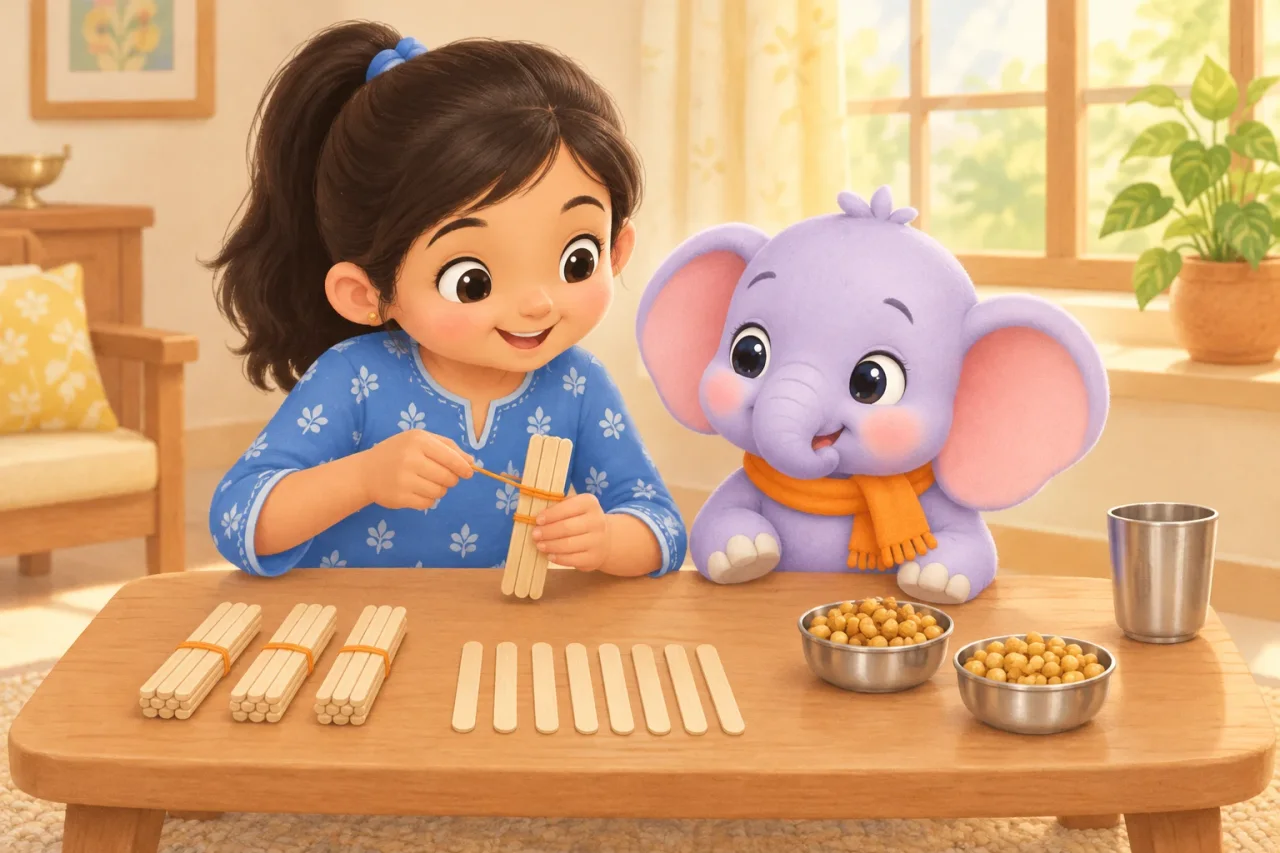
You need something your child can count into tens and tie up. Ice-cream sticks, old pencils, straws or matchsticks with the heads cut off all work, with rubber bands or hair bands to hold each bundle.
Sit together, count out ten sticks slowly, then band them. Tell your child, “This is one ten, with ten sticks inside.”
Then add, “Now we count it as one bundle.” Make five or six bundles on the first day, and let your child tie most of them.
For quicker work, use chana or buttons with small steel katoris, where a full katori holds exactly ten. Ten ₹1 coins against one ₹10 coin shows the same idea with money.
38 is 30 and 8
Put three bundles and eight loose sticks on the table and ask your child how many there are. Most will untie the bundles and count every stick.
Stop them gently and show the faster way. Count the bundles first, “ten, twenty, thirty”, then go on with the loose ones, “thirty-one, thirty-two”, up to thirty-eight.
Now say it three ways: “three tens and eight ones”, “thirty and eight”, “thirty-eight”. Write 30 on a strip of paper and 8 on a small square. Lay the 8 over the zero of the 30, and your child sees 38 appear.
Try a few more: 52, 17, 70, 46. Seventy is a good one, because nothing is loose and the zero has to hold the ones place.
Why carrying is just making a ten
Carrying is where place value earns its keep. Take 27 + 15. Put out two bundles and seven loose sticks, then one bundle and five loose sticks.
Push all the loose sticks together and count them: twelve. Ask, “Twelve loose sticks. Can we make a ten?”
Your child bands ten of them, and two stay loose. Now there are four bundles and two loose sticks, which is 42.
That new bundle is the “1” carried to the tens column in school. When your child writes it above the tens later, it is not a trick. It is a bundle they tied with their own hands.
Borrowing runs the other way: when there are not enough loose ones, you open a bundle. Keep that for after carrying feels easy.
The ten-minute routine
- Count bundles (two minutes). Put out some bundles and loose sticks. Your child counts the tens first, then the ones, and says the number.
- Build the number (three minutes). You say a number up to 99, and your child builds it. Then swap, and you build theirs.
- Split it (two minutes). Say a number and your child splits it aloud: “64 is 60 and 4.”
- One sum with a new ten (three minutes). Give one sum that crosses a ten, like 36 + 7. Your child joins the loose ones, ties a new bundle and says the answer.
Keep the same order each day. On tired evenings, use smaller numbers rather than skipping the routine.
Games for the kitchen and the bus
- Shopkeeper. Price things at ₹23 or ₹48 and pay with ₹10 and ₹1 coins. How many tens, how many ones?
- Bus numbers. Read a bus or house number aloud and say what the first digit is worth.
- Tens and ones dice. Roll two dice: one is the tens, one is the ones. Build the number and see whose is bigger.
- Swap shop. Ten loose chana can be swapped for one full katori. Count a big pile by swapping first.
- Mystery number. “I have four tens and three ones. Who am I?”
Mistakes worth avoiding
- Counting every stick. If your child unties bundles to count, remind them that a bundle is already counted: “That one is ten.”
- Reading 38 as “three, eight”. Always say the full number and its parts together.
- Jumping to columns. The written column method makes sense only after the bundles do, so do not rush it.
- Skipping the teens. Eleven to nineteen do not sound like their parts, so build them often: one bundle and some loose.
- Ignoring the zero. Numbers like 40 and 70 need practice, because the zero means “no loose ones”.
A checklist for the fortnight
- Ten bundles of ten sticks, banded, kept in one box
- Count tens first, then ones
- Say every number as tens and ones
- Build one number with a zero each day, like 50
- One sum a day that makes a new ten
- Praise the thinking: “You made a new bundle!”
- Columns on paper only after the bundles feel easy
Try it in TypeMasti
In the Numbers world, the unit Numbers to 100 begins with Tens: 10 to 100. Masti reads each prompt aloud, your child counts bundles of ten sticks in tens and types the number they see, all the way up to a hundred. After that, Skip patterns in the Thinking world asks for the next number in “30, 40, 50”, which is the same counting in tens in a new shape.